
CHAPTER 1: SINGAPORE
After the sun has set, the temperature in Singapore becomes more oppressive. It’s a fact. The air contains so much moisture that evaporation of sweat becomes less effective, so your body doesn't cool efficiently. You sweat, as they say, like a pig. Which of course they don't. They wallow in mud or water and as the water evaporates it cools their skin. (You might be interested in the 'Coolgardie meat safe' which operates on a similar principle to keep meat fresh.)
When I went looking for my favourite roti paratha shop, the sweat was starting to build up beneath my T-shirt and I began trying to find a shop selling cool drinks. I remembered exactly where the roti shop was—or thought I did.
I have a good memory of the roti place — the shop used to be in Geylang Road just up around the corner from the hotel down Lorong 6.
I usually stay in the red light district when I'm in Singapore because the hotels are not so expensive, they appreciate a long-time customer—as opposed to short-time occupants—and more importantly the neighbourhood has the best roti paratha and curry sauce I know. Or did have.
I had a clear picture in my mind of the roti shop which had stood along that thoroughfare for as long as I can remember.
Half of its front was a sign board with pictures of various dishes of curries: vegetarian, chicken, goat, fish. Halal Indian Muslim curry! Down the left hand side of the eating house stretched a line of small tables ending up about three quarters of the way down with a desk where a Chinese man sold beer and other drinks. The restaurant was halal; the beer was presumably another matter.
On the right about halfway down was the roti maestro who flings, stretches, slaps and turns the dough until it becomes almost translucent. When it was thin enough, the cook coiled it to a small circle, squashed it a little and put it on the griddle to cook. Crunchy bread to be served with curry sauce.
Continuing with my mind’s eye: on a grubby ceiling, there were two overhead fans beating to little effect, and at the rear of the shophouse rose an elderly wooden staircase to God knows where. Now and again an Indian man would appear from the street, walk the length of the eating house and disappear upwards into the gloom.
Above was either a cheap boarding house or a knocking shop. Or maybe both. I was never inclined to venture above to find out. Beneath the stairs were stacked sacks of rice, bags of cement, crates of soda, folding chairs and commodities of the like. I invariably drank one beer while eating the paratha and took another can back with me to sup in the hotel.
That was what I remembered.
But the original eating house was no longer there, neither was its dough maestro, nor was its Chinese beer seller. In its place was another restaurant much cleaner, brighter and well ventilated than the original.The curry was familiar enough, the bread was close enough, and the beer was just as cold. Yet somewhere between one side of Geylang Road and the other lay the distance between remembering and returning.
I was disappointed, but after wandering for five minutes, I found a similar establishment across the road.
I do not have teddy bear sex anymore -- a lack of flexibility in the thigh muscles -- though I do miss the strawberry jam at the end.
THINKING ABOUT THINKING
The Neuron — The Messenger
If we are going to understand memory, consciousness, thought, fear, pleasure, or even the strange experience of arriving alone in an unfamiliar railway station, we must begin with something surprisingly small: the neuron.
A neuron is a specialised living cell whose job is to receive, process and pass on information. There are billions of them in the human brain, each connected, directly or indirectly, with vast numbers of others. Individually, a neuron is not particularly impressive. It cannot think. It does not contain a memory of your childhood or an opinion about the hotel you have just checked into.
But put roughly 86 billion of them together, connect them in extraordinarily complicated ways, and something remarkable happens. You happen.Your memories. Your fears. Your personality. The sound of music. The taste of mango. The face of someone you loved fifty years ago. The irritation of being stuck on a third-class train. The sudden feeling, on arriving somewhere entirely new, that you are awake and intensely alive. All of these experiences depend upon neurons communicating with one another.
The anatomy of a neuron
A typical neuron has several important parts.The dendrites are like branches growing from the cell. Their job is largely to receive information from other neurons. Thousands of signals may arrive at a neuron through these branching structures.
At the centre is the cell body, which keeps the neuron alive and integrates much of the information it receives. You might think of it as the neuron's headquarters.If the incoming information is sufficiently important, the neuron sends a signal along a long fibre called the axon. This signal travels away from the cell body towards other neurons. But there is a catch. Neurons usually do not actually touch one another.
Between one neuron and the next is a tiny gap called a synapse. When an electrical signal reaches the end of an axon, it triggers the release of chemical messengers called neurotransmitters. These cross the tiny gap and influence the next neuron.
So the basic pattern is:Receive → decide → transmit → influence another neuron. And then it happens again. And again. And again. Millions of times every second: A conversation without end.
It is tempting to imagine the brain as a vast collection of tiny wires carrying messages from one place to another. But it is much more complicated than that.
A single neuron may receive signals from thousands of other neurons. Some signals encourage it to act. Others tell it not to. At every moment, countless cells are influencing one another in an immense, shifting conversation.
There is no single neuron in your head labelled MEMORY. Nor is there one labelled ME, FEAR, CHILDHOOD, or WHERE THE HELL AM I?
Instead, experiences are represented by patterns of activity across networks of neurons.When you recognise the smell of rain in Singapore, for example, one group of neurons may be processing the smell itself. Others may be connecting it with memories. Others may be involved in emotion. Others may be preparing your body to move. The experience emerges from the interaction of the whole network.
The first great idea for you to grasp is that the brain does not work because individual neurons are clever. It works because neurons are connected.
From simplicity to complexity
This is one of the extraordinary things about the brain. The individual parts are relatively simple.
A neuron receives signals. It responds according to certain rules. It sends signals onwards. Yet from the interaction of billions of these simple cells emerges something unimaginably complicated.
A symphony is not contained in a single violin; a city is not contained in a single house; and you are not contained in a single neuron.
You are, in some sense, an ever-changing pattern created by the activity of billions of cells communicating with one another. The neurons themselves are constantly changing their connections and their strength of communication. Experiences alter the network. Learning alters it. Trauma alters it. Repetition alters it.This ability of the brain to change will become increasingly important when we come to memory.
The traveller's parallel
A traveller provides a useful way of thinking about this. Imagine arriving in a completely unfamiliar place. You step off the train. Immediately your senses begin collecting information. Your eyes notice the architecture. Your ears register unfamiliar languages and the sound of traffic. Your nose detects food, drains, incense, diesel.You are trying to work out where you are, where you are going, whether you are lost, whether that man is a taxi driver, and whether the hotel you booked actually exists. No single neuron understands the situation.
Instead, vast networks of neurons are working together. Some process what you see; some what you hear; some compare the present with memories of previous journeys; some are involved in attention; some in emotion; some in deciding what to do next.
Out of all this electrical and chemical chatter comes a simple conscious experience: I have arrived somewhere new.That is the astonishing journey we are about to explore and we begin with a tiny cell – the neuron. And from that tiny cell, eventually, we will arrive at memory, identity, imagination and perhaps the most mysterious question of all: How can billions of communicating cells produce the experience of being you?
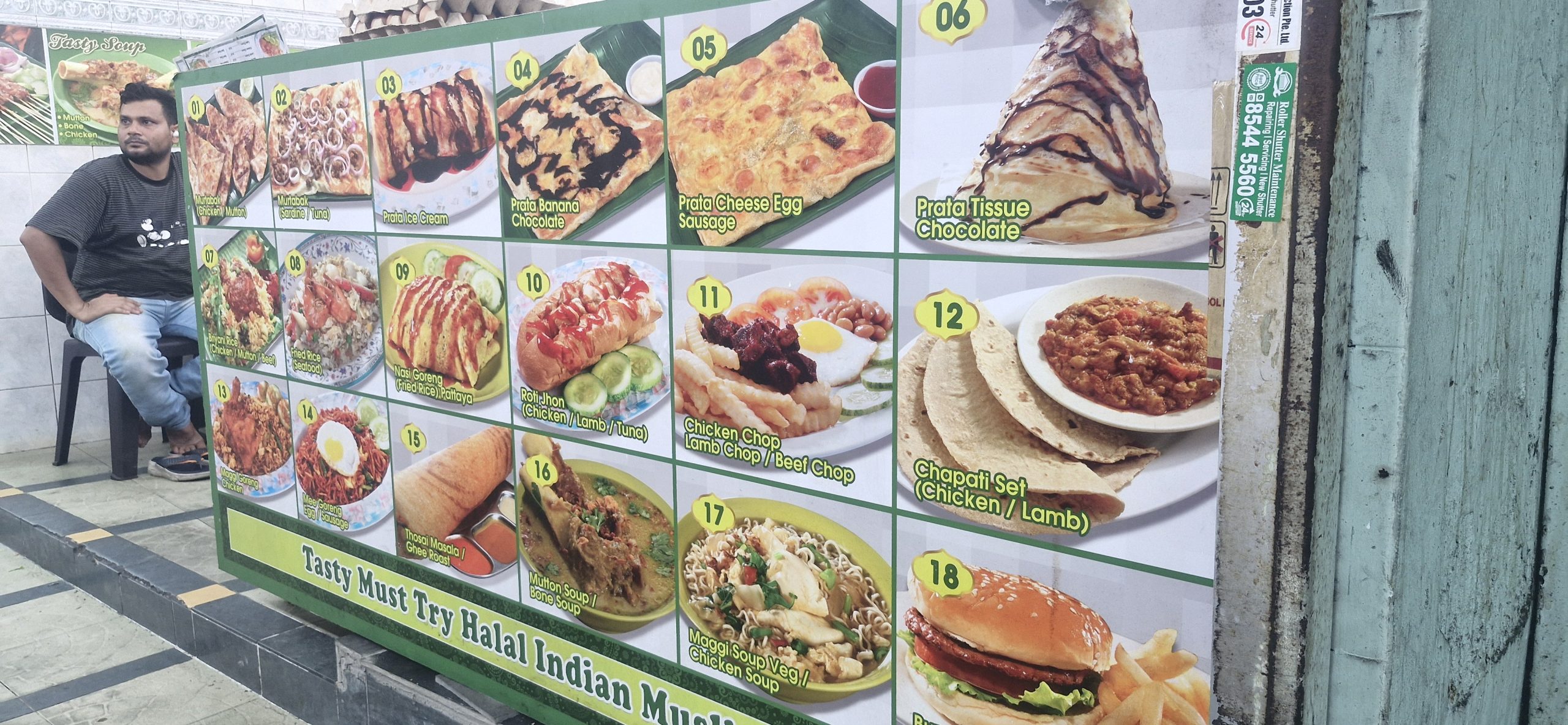
There the roti paratha was not as crispy when compared to the original. But it was sufficient unto the moment. I did not spend much time wandering in Singapore that evening.

There were no seats in the waiting area, so I quietly occupied one of the First Class chairs. Nobody challenged me and, when boarding was finally announced, I was first through the barrier.
The train is excellent: clean, comfortable, and decorated with advertisements showing impossibly happy families.
An electronic display announces the next station, the train's speed and the outside temperature. We are approaching Paloh station at 137 kilometres an hour, according to the display, while outside it is a surprisingly cool 18 degrees. The next stop is Gemas, where the railway line divides: one line heads up Malaysia's east coast towards Kota Bharu, the other continues north through Kuala Lumpur to Padang Besar on the Thai border.
Shortly after two o'clock, with the train flying through the countryside, I received a call from someone claiming to be from the Commonwealth Bank. A young woman politely enquired about an $1,800 transfer I supposedly wished to make.
I thanked her for her concern and suggested, just as politely, that she disembark with some haste at the next stesen.
I was almost grateful for the scam call. It served as a timely reminder that the predators are everywhere. One thing did puzzle me, though. My phone wasn't connected to the internet, yet they reached me without the slightest difficulty.
How do they do that? Sometimes I feel modern technology has passed me by. Invisible systems are everywhere.
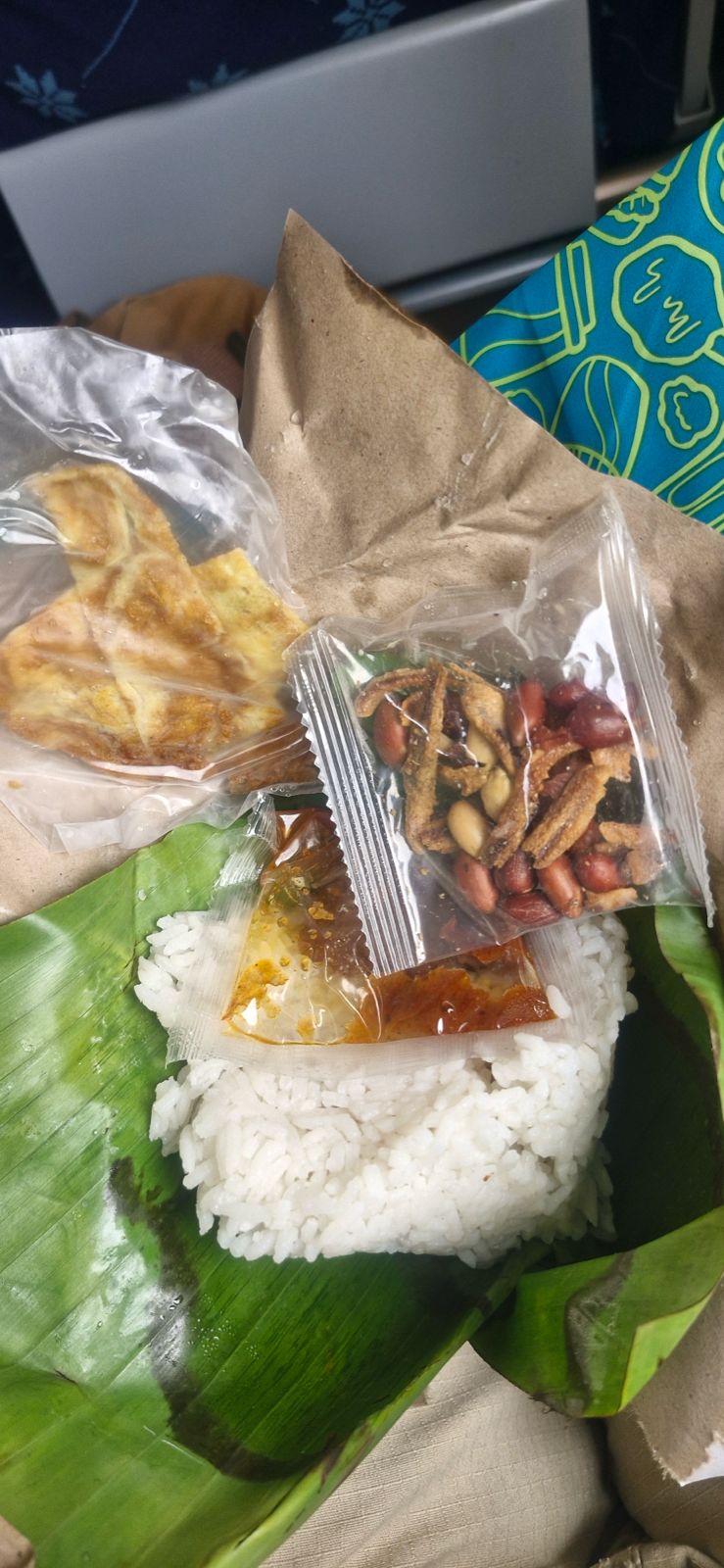
I bought from the train provision dispenser a bundle of nasi lemak wrapped in greaseproof paper. Coconut rice, peanuts, small dried fish, fried egg and of course sambal. Disappointingly it was only mildly spicy. The Malaysian sambal is generally sweeter than that in Indonesia although regional variations can be
Type your paragraph here